
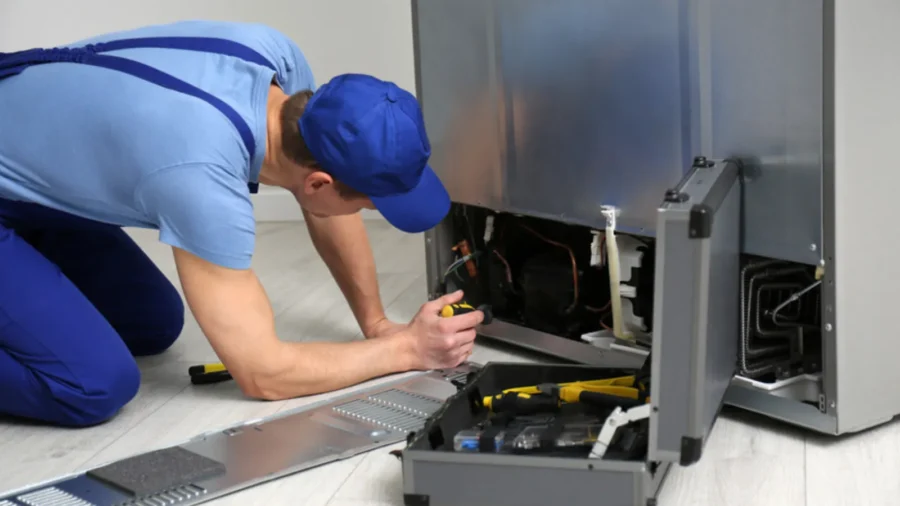
Luis was tired of jobs that changed every few months. A neighbor who fixes air conditioners said the work never really stops. Before spending anything, Luis wanted neutral facts about the career and a way to compare real programs. 🤔
👉 SEE THE 6-STEP PLANStep-by-step guide on the next pageWhat you’ll find here
✔️ What HVAC technicians do.
✔️ The usual path to get started.
✔️ Where to compare training near you.
✔️ Licenses, certifications and apprenticeships.
🧾 What the job is
CareerOneStop, sponsored by the U.S. Department of Labor, describes the work as installing or repairing heating, central air conditioning, HVAC or refrigeration systems.
Day to day, it can mean talking with customers about a problem, testing electrical circuits and repairing parts. You may see the job called HVAC tech, AC tech or refrigeration technician.
🎓 The usual starting point
According to CareerOneStop, people starting in this career usually have a postsecondary certificate, no prior work experience and more than one year of on-the-job training.
Programs that prepare for it are often listed under names like HVAC&R Maintenance Technology/Technician. Knowing that name helps when you search.
📈 What the outlook says
CareerOneStop lists the occupation as expected to grow much faster than average, with employment projected to rise about 11% from 2025 to 2035 and roughly 40,600 openings a year in the U.S.
That is a picture of the field as a whole. It is useful context, not a promise for any one person.
👉 HOW TO COMPARE PROGRAMSThe checklist, on the next page🔎 Where to compare programs
CareerOneStop has a Local Training Finder that searches programs by occupation and location across the U.S., including short-term programs and two- and four-year college programs.
It is a neutral starting point: you compare first, and only then contact schools.
🪪 Licenses and certifications
Some states require an occupational license for this work, and CareerOneStop has a tool to check license details by state. Certifications can also help you get a job or a promotion.
Checking both early helps you pick a program that fits the rules where you live.
🛠️ Learning on the job
Apprenticeships combine paid on-the-job training with classroom lessons. The career profile links to a tool that finds apprenticeship opportunities, which is helpful in a field where much of the learning happens at work.
🧭 Is it a fit for you?
A few honest questions help: do you like solving practical problems, working with your hands and explaining things to people? Are you comfortable with electrical testing and with working in different homes or buildings?
CareerOneStop’s profile lists the kind of tasks involved, from testing circuits to repairing parts, so you can picture a normal day before you commit. If those tasks sound interesting rather than stressful, it is worth taking the next step and comparing programs.
On the next page: a six-step plan to go from “maybe” to a short list of real programs, plus the questions to ask before you sign.
Quick questions
Is this a government website?
No. PlanoSimples is an independent guide.
Do you offer courses or jobs?
No. We explain how to find and compare programs using public tools.
👉 READ THE FULL PLANStep by stepPlanoSimples is an independent publisher, not affiliated with the U.S. Department of Labor, CareerOneStop, any school, any employer or any government agency. We don’t offer courses or jobs and we never ask for personal details. Independent guide. Not affiliated with any government agency.